Listen On


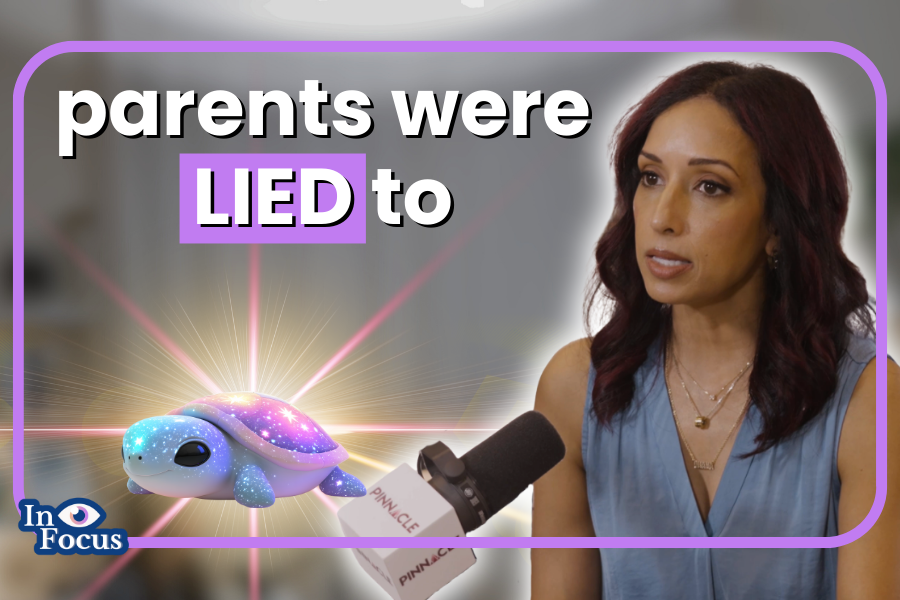
In 1999, a study came out that terrified parents across the country.
The headline was simple and alarming: If you leave a night light on for your baby, you’re making them nearsighted.
The numbers were staggering. According to the study, children who slept with a room light on had a 55% chance of needing glasses later in life. For years—decades, really—parents took this to heart. They stumbled through dark hallways, stubbed their toes on toys, and worried that a tiny glow in the corner of the nursery was permanently damaging their child’s eyes.
But here’s what most parents were never told:
That study missed one crucial question.
And once you ask it, the entire story changes.
I’m Dr. Rupa Wong, pediatric ophthalmologist and mom of three. Welcome to In Focus, where we talk about parenting in today’s world—eye health, screen time, social media, and how to raise confident, healthy kids without fear driving every decision.
Today, we’re revisiting that night-light myth with updated science—and I’m giving you the permission you’ve probably been waiting for.
Let’s talk about what actually matters.
The Invisible Backpack We All Carry
Before we dive into the data, I want to name something many parents carry without realizing it.
I call it the Invisible Backpack.
It’s heavy. It’s full of “shoulds.”
I should have breastfed longer.
I shouldn’t have let them watch the iPad during dinner.
I should have bought organic strawberries.
That backpack is mom guilt.
And yes—dad guilt exists too.
Lately, I’ve had exhausted parents in my clinic tell me they’re afraid to use a night light. They’ve seen the headlines resurface on social media. They’re navigating their homes in complete darkness, convinced that a one-watt bulb is going to ruin their child’s vision forever.
So let me say this clearly, as both a pediatric ophthalmologist and a parent:
You can put that guilt down.
The science has evolved.
And that original study was deeply flawed.
Where the Fear Came From: The 1999 Study
In 1999, a study published in the journal Nature examined 479 children. Parents were asked to recall the lighting conditions in their child’s bedroom before age two.
The reported results were dramatic:
9% of children who slept in darkness developed myopia
34% who slept with a night light developed myopia
55% who slept with a full room light developed myopia
On paper, that looks terrifying. But when you look closely, three major problems emerge.
1. Selection Bias
These children were recruited from a tertiary academic eye clinic—not from the general population. That alone skews results toward children already more likely to have vision concerns.
2. Recall Bias
Parents were asked to remember nursery lighting from years earlier. Most of us can’t remember what our kids ate yesterday—this is not reliable data.
3. The Biggest Miss: Genetics
This is the flaw that changes everything.
Nearsighted parents are more likely to:
Leave lights on at night so they don’t trip
Have children who are genetically predisposed to myopia
The night light wasn’t causing nearsightedness.
It was simply a marker for parental vision.
What Happened When Researchers Did It Right
Once that study was published, the scientific community took a closer look.
A much stronger follow-up study—the CLEERE study—examined 1,220 children, controlled for ethnicity, and crucially, accounted for parental myopia.
The result?
No association.
Once genetics were factored in, the night-light effect disappeared completely.
Additional studies from Singapore and the UK confirmed the same finding using objective eye measurements. The conclusion was consistent:
Night lights do not cause nearsightedness.
What the New 2025 Research Actually Shows
Does lighting matter at all?
Yes—but not in the way we were told.
The conversation has shifted from night light vs. no night light to timing and intensity of light exposure.
A new 2025 study used wearable photometers to measure actual light exposure in children—no parental recall involved. And what they found was a “Goldilocks effect.”
What Matters:
Bright light (>30 lux) immediately after falling asleep
→ Disrupts deep sleep cycles and circadian rhythmSoft light (10–30 lux) in the early morning hours
→ Can be protective and help reset circadian rhythmsStandard night lights (~1 lux or less)
→ No increased risk
The issue isn’t a small, dim glow.
It’s bright artificial light at the wrong time.
Why This Comes Down to Biology (Not Guilt)
Light affects dopamine signaling in the retina—dopamine helps regulate eye growth. Disrupted sleep and mistimed bright light interfere with melatonin and circadian rhythms, which can indirectly influence eye development.
A dim night light in the corner of the room?
That’s not enough to disrupt this system.
My Practical, Parent-Friendly Night Light Guidelines
Here’s what I recommend in real life:
1. Night lights are okay.
Please don’t trip in the dark. If it soothes your child and helps everyone sleep, that matters.
2. Keep it dim.
Aim for 1 lux or less. If you can read a book by it, it’s too bright.
3. Choose warm light.
Amber, red, or soft white (~2700K). Avoid blue or cool white light—those suppress melatonin.
4. Emotional safety matters.
If your child is afraid of the dark, the cortisol spike from fear is far more harmful than a dim night light.
What Actually Matters for Nearsightedness
If you’re worried about myopia, focus here instead:
Outdoor time:
Aim for 2 hours a day. Sunlight increases retinal dopamine and can reduce myopia risk by up to 50% in some studies.Manage near work:
Use the 20-20-20 rule. Screens at arm’s length.Know your family history:
Genetics still play the biggest role.
Professional organizations like the American Academy of Ophthalmology and the American Association for Pediatric Ophthalmology and Strabismus do not list night lights as a risk factor for myopia.
If a prescription is changing, it’s not because of a night light from years ago.
The Bottom Line
That 1999 study scared a generation of parents—but it didn’t account for genetics.
Night lights are safe.
Your child’s vision is shaped by DNA, screen habits, and time outdoors—not a soft glow in the nursery.
So tonight, turn on the night light if you need it.
Kiss your kids goodnight.
And get some guilt-free sleep yourself.
Want to Learn More?
This is just the beginning. In upcoming episodes, we’ll explore:
-How screen time and digital habits are shaping our kids’ development
–The connection between vision and overall health
–What you need to know about common eye procedures like LASIK and cataract surgery
–Practical ways to advocate for your child’s visual needs
You can subscribe to my podcast, In Focus, anywhere you listen—or follow along on Instagram for updates and tips.
Watch this episode on Youtube right now!
Thanks for reading—and for doing what you can to protect your child’s vision, one step at a time.
– Dr. Rupa Wong
Pediatric Ophthalmologist | Surgeon | Mom of 3
This episode is brought to you by The Pinnacle Podcast Network! Learn more about Pinnacle at learnatpinnacle.com