
Online Safety 101: What Parents Aren’t Being Told About Their Kids’ Apps | Detective Michael Chun
Listen On


There are moments in parenting when something clicks in a way you can’t unsee.
This conversation was one of those for me.
As a pediatric ophthalmologist, I spend my days thinking about how children take in the world—how their eyes, their brains, and their developing nervous systems interpret what they see. But as a mom of three raising kids in a digital-first generation, I’m also constantly asking a different question:
What are they being exposed to when I’m not in the room?
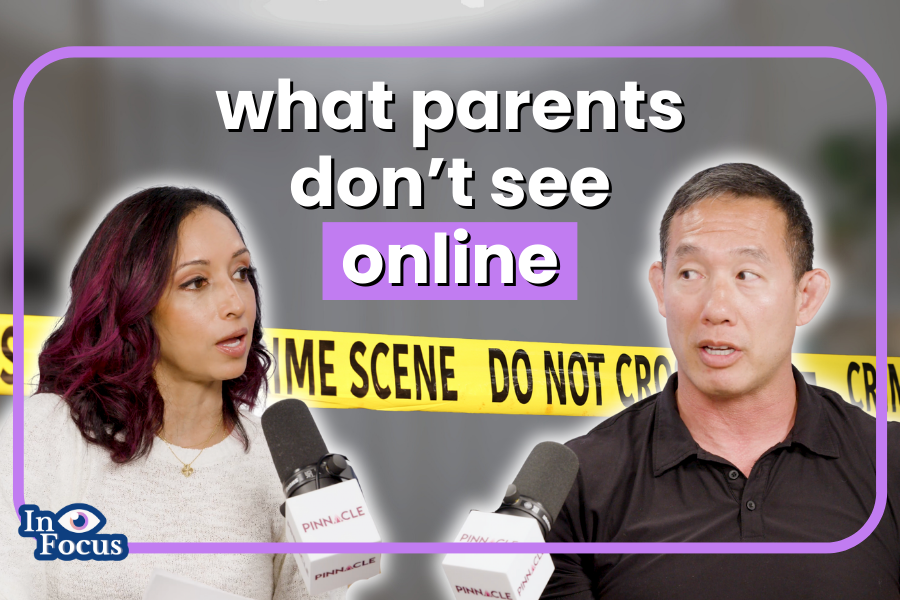
That’s why I sat down with Detective Michael Chun, a longtime law-enforcement investigator who spent years in crimes against persons — everything from stalking to exploitation to online grooming. What he shared wasn’t dramatic. It was calm. Measured. And somehow even more unsettling because of it.
Not because the world is suddenly dangerous.
But because the rules of safety have changed.
We Still Parent Like It’s 1995
Most of us grew up with a very physical version of “stranger danger.”
Don’t talk to people in parking lots.
Don’t wander off in stores.
Stay where your parents can see you.
That model worked because risk required proximity.
But now, a child can be contacted from their bedroom.
Through a game.
A chat.
A shared video.
A profile picture.
And what struck me most from Detective Chun’s work is this:
Predators no longer have to approach children.
They wait for children to come to them.
Gaming platforms. Comment sections. Social feeds.
They are not just entertainment spaces.
They are digital neighborhoods.
And most parents are not walking through them with their kids.
Grooming Doesn’t Look Like What We Think
When we imagine danger, we think of dramatic moments.
But real grooming is slow.
It starts with something small:
“Where are you from?”
“What grade are you in?”
“Do you have siblings?”
Each answer becomes a data point.
California → Middle school → Home alone after school.
The child doesn’t feel unsafe.
They feel seen.
That’s what predators look for.
Not disobedience.
Not recklessness.
But openness.
Detective Chun explained how, in investigations, offenders assess not just children — but parents. How present are they? How protective? How much access does this child really have? That calculation now happens digitally, quietly, over weeks or months.
Why Parental Controls Alone Are Not Enough
Many families do what we did at first:
Strong filters. Limited apps. Locked-down Wi-Fi.
And those tools matter. But they create a false sense of security.
Because kids don’t get into trouble only by breaking rules.
They get into trouble by being curious.
And algorithms are designed to feed curiosity.
One innocent school video becomes something else.
One search becomes ten suggestions.
And suddenly a child is being exposed to things they never intended to look for.
What protects them in those moments is not software.
It’s context.
Children who have been taught how to evaluate what they see are far safer than children who have simply been restricted from it.
Situational Awareness — But for the Internet
In law enforcement, Detective Chun talks about something called situational awareness — the ability to read an environment for risk.
We teach it in parking lots.
On sidewalks.
In crowds.
We rarely teach it online.
But we should.
This can be as simple as:
Watching a show together and asking,
“Why do you think that character trusted that person?”
Looking at a social media profile and saying,
“What can you tell about this person just from their posts?”
Letting your child discover how much information can be pulled from something as small as a photo.
Because once they see how easy it is to find things…
They become much more thoughtful about what they share.
The New Fear Parents Don’t Talk About: AI
This was one of the most sobering parts of our conversation.
With just a few seconds of someone’s voice, AI can now recreate it.
Which means a phone call that sounds exactly like your child could be fake.
A FaceTime could be fabricated.
A video could be generated.
Detective Chun shared how scammers already use this to create panic — convincing parents their child is in danger and demanding money.
One of the simplest and smartest things we’ve done in our home is create a family safe word.
If my kids ever receive a message or call that feels strange, they ask for it.
No safe word = not real.
It’s not paranoid.
It’s prepared.
How You Build a Child Who Comes to You
The goal is not to make kids afraid.
The goal is to make them comfortable telling you when something feels off.
That starts with:
Talking about characters instead of accusing your child
Using shows, stories, and news as conversation starters
Making curiosity safe instead of punishable
Shame is what keeps kids quiet.
Connection is what keeps them protected.
You Don’t Have to Do Everything. You Just Have to Start.
This world is overwhelming.
But you don’t have to master it all at once.
Turn off messaging in games.
Have one conversation this week.
Show one example.
Ask one curious question.
Safety in the digital age is not about control.
It’s about relationship.
And that — just like vision — is something we can protect, if we stay present enough to see what’s really there.
Want to Learn More?
This is just the beginning. In upcoming episodes, we’ll explore:
-How screen time and digital habits are shaping our kids’ development
–The connection between vision and overall health
–What you need to know about common eye procedures like LASIK and cataract surgery
–Practical ways to advocate for your child’s visual needs
You can subscribe to my podcast, In Focus, anywhere you listen—or follow along on Instagram for updates and tips.
Watch this episode on Youtube right now!
Thanks for reading—and for doing what you can to protect your child’s vision, one step at a time.
– Dr. Rupa Wong
Pediatric Ophthalmologist | Surgeon | Mom of 3
This episode is brought to you by The Pinnacle Podcast Network! Learn more about Pinnacle at learnatpinnacle.com