Biohacking Your Morning for Peak Energy
Listen On


As a pediatric ophthalmologist and mom of three, I spend a lot of time thinking about energy, not just physical energy, but mental clarity. How do you wake up feeling grounded instead of already behind? How much of your brain power is being hijacked before your feet even hit the floor?
If your alarm goes off and your first move is reaching for your phone, you’re not alone.
I did that for years.
I’m a surgeon. I run a business. I have three kids. And like many of you, I don’t have time for a two-hour spa morning. But I do have time for biology.
And that’s where everything changed.
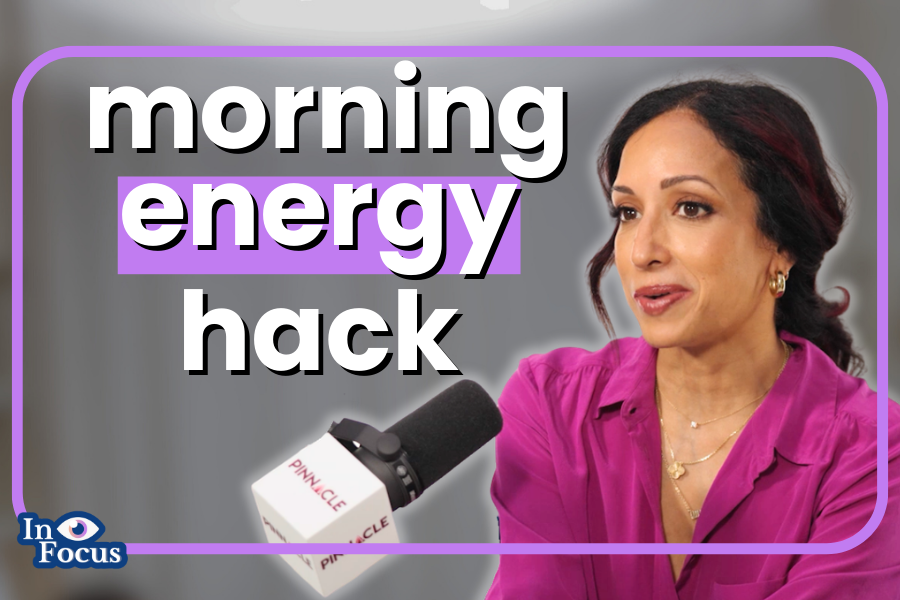
In this episode of In Focus, I walk you through what I call the Visual Anchor Routine, a simple, science-based system that uses light, hydration, and dopamine control to reset your energy for the entire day.
Not self care.
System care.
Why Your Morning Feels So Hard
Let’s talk about that familiar routine.
The alarm goes off. One eye opens. Your eyes feel gritty and dry. You grab your phone. The screen lights up your dark room. Suddenly you’re checking email, scrolling Instagram, responding to texts that came in while you were asleep.
Before you’ve even stood up, your cortisol is spiking and your brain is already in reactive mode.
I know this pattern because I lived it.
We’re told that better mornings require meditation, gratitude journaling, green juice, or yoga on the beach. But most of us are juggling school drop-offs, forgotten water bottles, last-minute uniforms, and packed schedules.
So instead of adding more to your plate, I want you to leverage the hardware you were born with.
Your eyes.
Most people think eyes are just cameras.
They’re not.
Your Eyes Are Part of Your Brain
Your eyes are the only part of your central nervous system that lives outside your skull. They directly communicate with a tiny structure deep in your brain called the suprachiasmatic nucleus, your master clock.
This clock controls your hormones, sleep, mood, metabolism, and energy.
But here’s the key. It’s blind.
It depends entirely on signals from your eyes, specifically special cells that respond to light. When morning sunlight hits your retina, three powerful things happen:
Melatonin, your sleep hormone, shuts off
Cortisol rises in a healthy way, nature’s caffeine
A timer starts for tonight’s sleep
That light you get in the morning is what helps you fall asleep later.
When you don’t get it, your whole system drifts.
You feel tired until noon. Wired at night. Foggy during the day. Irritable with your kids. Dependent on coffee. Crashing at 2pm.
Light isn’t a luxury.
It’s a nutrient.
And most of us are malnourished.
The Visual Anchor Routine: Three Simple Steps
This routine is free, fast, and grounded in biology.
Think of it as flipping the main breaker switch for your body.
1. First Light
Before email. Before social media. Before news.
Get outside.
Natural light needs to hit your eyes directly. No sunglasses. No windows. Just step onto your porch, walk the dog, or stand in your driveway.
Ten minutes is enough.
Even on a cloudy day, outdoor light is dramatically brighter than anything in your house.
This one habit changed my energy more than any supplement I’ve ever tried.
If it’s still dark where you live, use a light panel rated at 10,000 lux and keep it in your peripheral vision while you start your morning.
You’re telling your brain it’s time to perform.
For teens especially, this matters. Their circadian rhythms naturally shift later during puberty, which is why they want to stay up late and sleep in. Morning light is the single most powerful way to pull their clocks back and help them fall asleep earlier.
They aren’t lazy.
Their biology is changing.
2. Hydrate Before Coffee
That gritty feeling in your eyes when you wake up?
Sometimes it’s dry eye.
Sometimes it’s dehydration.
You haven’t had water in eight hours. Your tear film becomes concentrated and salty overnight, creating friction on the surface of your eye.
Before coffee, try drinking 8 to 16 ounces of water.
I keep a bottle on my nightstand. I sit up and drink it before anything else.
It’s like lubricating your engine before you start driving.
Even mild dehydration can cause brain fog. If you want clarity, start with fluids.
3. Delay the Scroll
This one is hard.
Opening your phone first thing floods your brain with cheap dopamine and trains you to be distracted. You immediately enter reactive mode, responding to everyone else’s needs before checking in with yourself.
So I created a system.
My phone doesn’t sleep next to my head anymore. It charges outside the bedroom. That forces me to physically get up and see morning light before unlocking it.
If there’s a true emergency, people know to call twice.
The scroll is stealing your morning.
Take it back.
Let’s Recap
Here’s the Visual Anchor Routine:
Drink water before anything else
Get outside for 10 minutes of morning light, or use a 10,000 lux lamp if needed
No phone until you’ve seen the sun
That’s it.
When you do this, you aren’t just waking up.
You’re optimizing your entire system.
You’ll feel sharper in meetings. Less irritable with your kids. More focused during the day. And you’ll sleep better at night.
Your Morning Assignment
Try it tomorrow. Just once.
Skip the scroll. Drink the water. Step outside.
Notice how 10am feels.
Notice how 10pm feels.
Small shifts create massive change.
If this episode resonated, share it with a friend, leave a review, or subscribe so you don’t miss future conversations. And if you try the Visual Anchor Routine, I’d love to hear how it goes.
Vision isn’t just about seeing clearly with your eyes.
It’s about seeing your life clearly.
And designing your days with intention.
Want to Learn More?
You can subscribe to my podcast, In Focus, anywhere you listen—or follow along on Instagram for updates and tips.
Watch this episode on Youtube right now!
Thanks for reading—and for doing what you can to protect your child’s vision, one step at a time.
– Dr. Rupa Wong
Pediatric Ophthalmologist | Surgeon | Mom of 3
This episode is brought to you by The Pinnacle Podcast Network! Learn more about Pinnacle at learnatpinnacle.com