How Many Hours of Screen Time Is Too Many for Your Child’s Eyes?
SCREEN TIME & KIDS' WELLBEING | DRRUPAWONG.COM
A 335,000-child study published in JAMA Network Open finally has an answer — and the number may surprise you.
The Question I Get Asked Every Single Week
Every week, a parent sits across from me in the exam room and asks some version of the same question: “How much screen time is actually okay?” And for years, my honest answer was: “We don’t have great data.”
The American Association of Pediatric Ophthalmology & Strabismus and the Academy of Pediatrics had general guidelines. We knew screens before bedtime disrupted sleep. We knew outdoor time was protective against myopia. But a clear, evidence-based answer about screen time and nearsightedness specifically? The research was inconsistent and the studies were small.
A 2025 systematic review and dose-response meta-analysis published in JAMA Network Open just changed that. And as a pediatric eye surgeon who has watched myopia rates climb steadily in my own clinic over the past two decades, I think every parent needs to understand what it found.
What This Study Is — and Why It Matters
The Ha et al. study (JAMA Network Open, February 2025) is the largest and most comprehensive analysis of screen time and myopia to date. The researchers pooled data from 45 studies involving 335,524 children and young adults, with a mean age of 9.3 years. They then performed something called a dose-response meta-analysis — which means rather than simply asking “is there a link?” they asked “how much screen time corresponds to how much risk?”
The studies included in the analysis looked at smartphones, tablets, game consoles, computers, and televisions — all types of digital screens.:

What They Found
The headline finding: each additional hour of daily screen time was associated with 21% higher odds of myopia (OR 1.21; 95% CI 1.13–1.30).
But the more nuanced and clinically important finding is the shape of the dose-response curve. Risk did not increase linearly. It followed a sigmoidal (S-shaped) pattern:
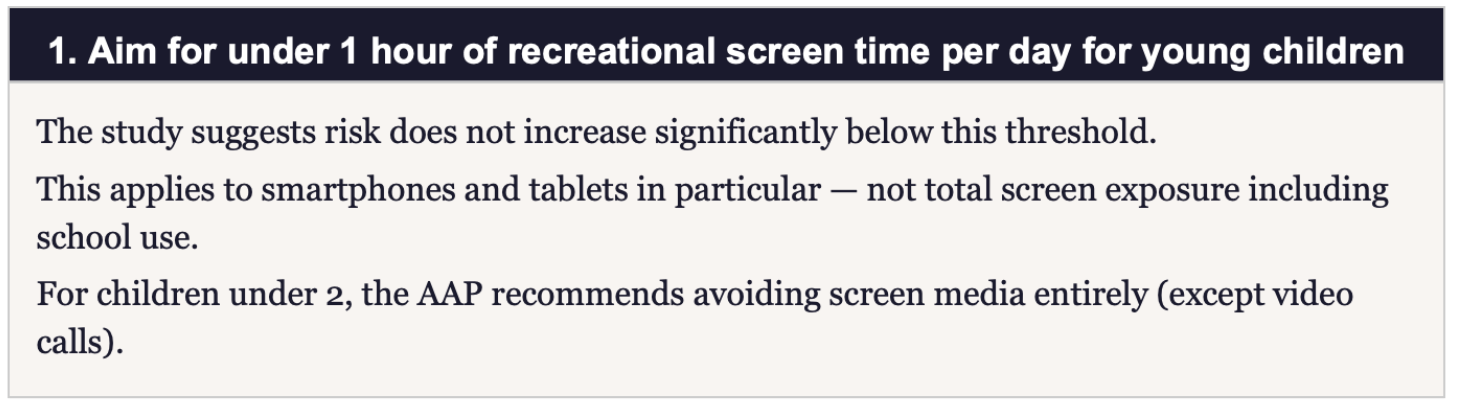
At or below 1 hour per day, the increased risk was small and not statistically significant.
Between 1 and 4 hours, risk climbed steeply — nearly doubling by the 4-hour mark.
Beyond 4 hours, risk continued to rise, but more gradually.
This matters because it suggests a potential safety threshold of under 1 hour per day — not because 1 hour is completely safe, but because that’s where risk begins to climb meaningfully.
The Numbers: Risk by Hours of Daily Screen Time
The following table is drawn directly from Table 2 of the study. These odds ratios represent the association between screen time and myopia compared to no screen time:
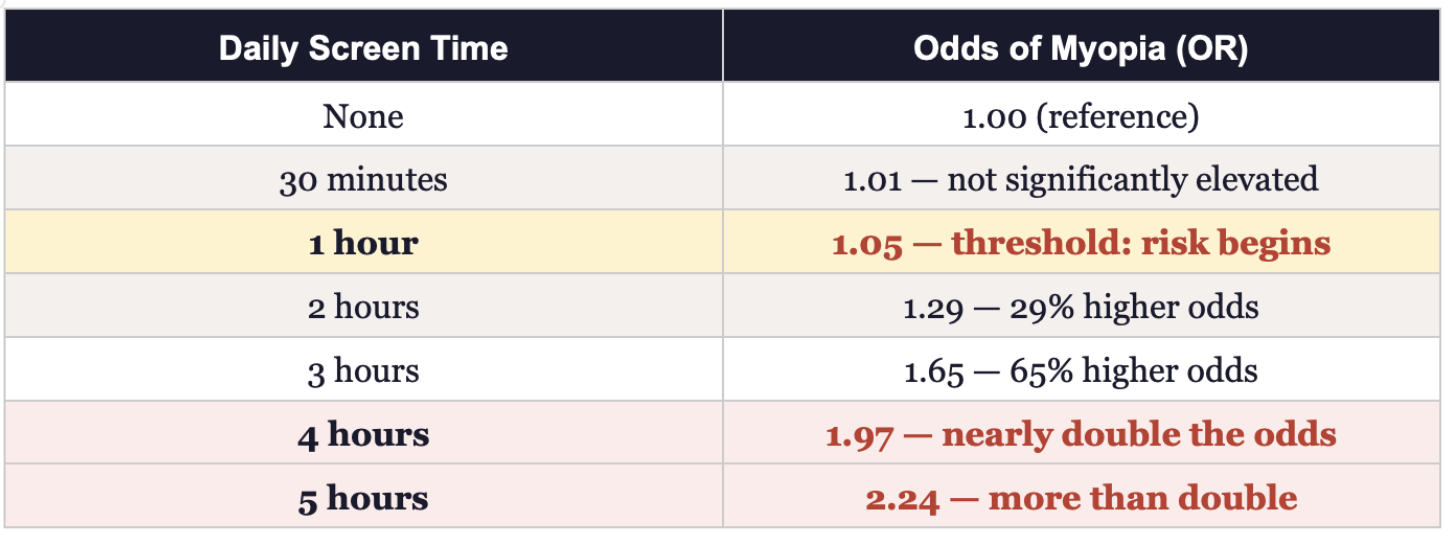
Source: Ha et al., JAMA Network Open. 2025;8(2):e2460026. doi:10.1001/jamanetworkopen.2024.60026
Toddlers and Preschoolers
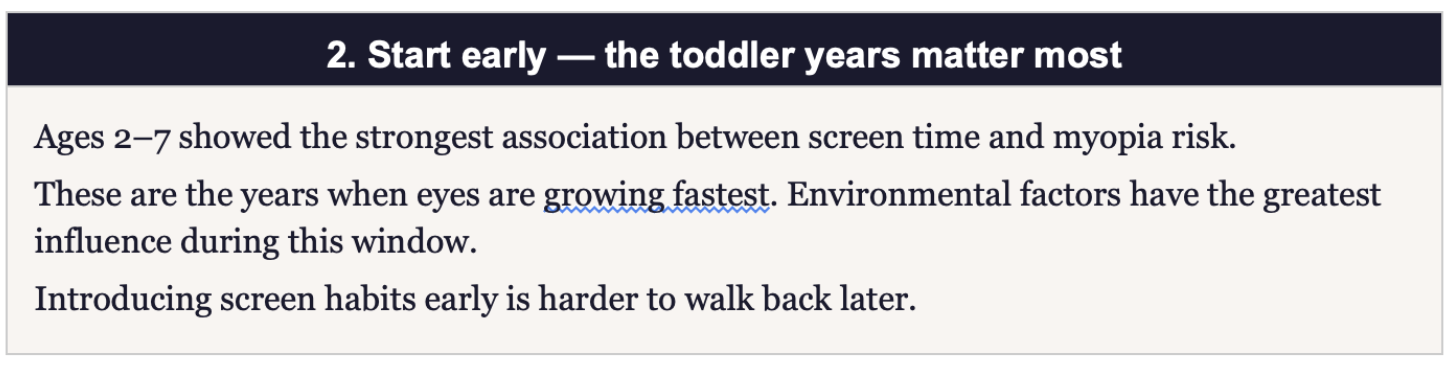
The study found a significant association between screen time and myopia across all age groups. But when researchers broke down the data by age, the strongest association was in children aged 2–7 years — not teenagers.
In the 2–7 age group: each additional hour of screen time was associated with 42% higher odds of myopia (OR 1.42; 95% CI 1.12–1.78). For ages 8–18, the figure was 12% per hour (OR 1.12).

Many 2-year-olds are spending up to 2 hours daily on tablets and phones. According to the study, this is precisely the developmental window where eyes are growing fastest and are most susceptible to environmental influences.
Why Phones and Tablets May Be More Harmful Than TV
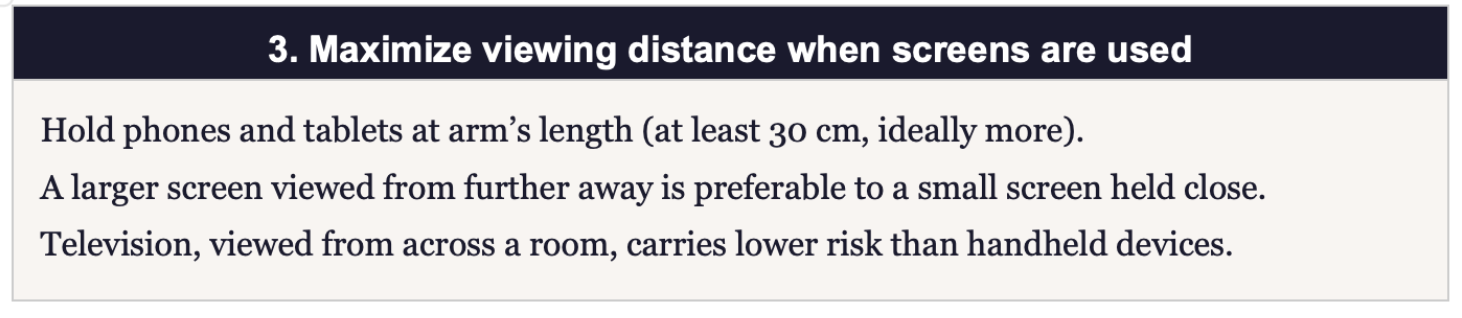
The study’s authors note something important: digital screens are not all equal. The research suggests phones and tablets may carry greater risk than television — not because of the content, but because of viewing distance.
Smartphones and tablets are typically held at 20–30 centimeters from the face. Television is viewed from several meters away. That close viewing distance places the device squarely in the high-risk zone for near-work-associated myopia. The eye is essentially doing continuous close-focus work for extended periods — and in young children, that sustained effort may accelerate eye elongation.
What About Outdoor Time?
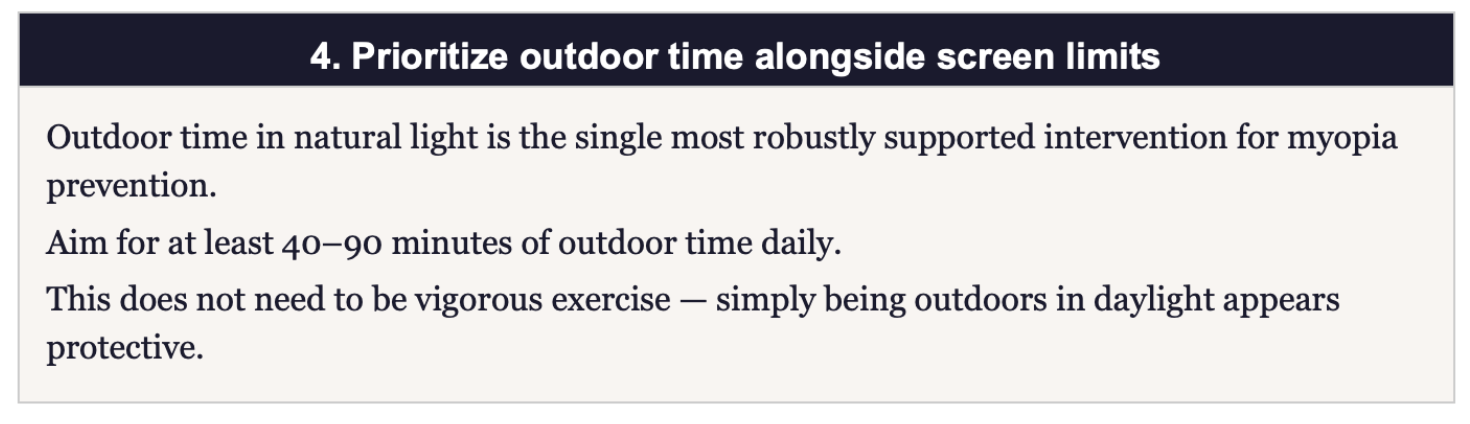
Outdoor time remains the most robustly supported protective factor against myopia onset. The study’s authors are explicit on this point: replacing screen time with traditional near-work activities (like reading) may not meaningfully reduce myopia risk, because the issue is the balance between near work and time spent outdoors in natural light.
The most effective approach is to minimize total near-work exposure while maximizing outdoor time — ideally at least 40 minutes to 2 hours per day. These are not competing strategies; they work together.
What This Study Can—and Cannot—Tell Us
I want to be transparent about the limitations, because I think scientific honesty is part of what makes this information trustworthy:
Low (GRADE framework): The overall certainty of evidence was rated
High heterogeneity across the 45 studies (I² = 99%) means the studies varied enormously in design, population, and methods. The true effect size may differ from the estimate.
Causation cannot be established. This is observational data:
Most studies are cross-sectional, meaning we can’t rule out that children already predisposed to myopia spend more time on screens.
independently of other near work: Screen time was assessed
The 1-hour threshold applies to screens alone, not total near-work exposure. A child doing 3 hours of homework plus 1 hour of screen time may have a different risk profile than the threshold implies.
relied largely on self-report. Screen time measurement
Objective measurement of screen habits in children is difficult, and questionnaire data introduces error.
None of these limitations mean the findings should be dismissed. The convergence of 45 studies pointing in the same direction, with a consistent dose-response relationship, is meaningful. But this is guidance, not gospel.
5 Things You Can Do Right Now
REFERENCES
[1] Ha A, Lee YJ, Lee M, Shim SR, Kim YK. Digital Screen Time and Myopia: A Systematic Review and Dose-Response Meta-Analysis. JAMA Netw Open. 2025;8(2):e2460026. doi:10.1001/jamanetworkopen.2024.60026
Rupa K. Wong M.D. is a pediatric ophthalmologist, practice owner at Honolulu Eye Clinic, and host of the In Focus podcast. This post is for informational purposes and does not constitute medical advice. Always consult your child's healthcare provider regarding individual concerns.