
Social Media and Your Kids: What the Largest Study to Date Actually Says
SCREEN TIME & KIDS' WELLBEING | DRRUPAWONG.COM
A new JAMA Pediatrics study followed thousands of kids from 4th through 12th grade. The answer to 'how much is too much' is more nuanced — and more useful — than you've been told.
My daughter doesn't have Instagram. She knows why — I've been talking about screen time and kids' vision for years, and she's heard every study. Which is why I was not entirely surprised when she sat down across from me recently, ready to make her case.
She had found the Singh et al. study published in JAMA Pediatrics in January 2026. One of the largest longitudinal studies on adolescent social media use ever conducted. And she had read it carefully.
"Mom," she said, "it says kids with no social media have worse well-being than kids with moderate use."
She's not wrong. She's also not entirely right. And the nuance between those two things is exactly what every parent of a tween or teen needs to understand.
The Study — What It Actually Found
Singh and colleagues followed thousands of Australian students from grades 4 through 12, measuring self-reported social media use and well-being across 8 validated domains annually. This is one of the few studies large enough and long enough to track how the relationship between social media and wellbeing changes as kids age.
The headline finding: a U-shaped curve. Adolescents who used social media in moderation generally had the best wellbeing. Both heavy users and teens who used no social media at all showed lower wellbeing scores.
Too much and none at all were both linked to worse outcomes. The goal isn't a ban. It's balance.
But — and this is critical — the findings look very different depending on your child's age and sex. Collapsing everything into one recommendation misses the entire point of the study.
What the Data Says for Girls
The findings for girls showed a clear developmental shift:
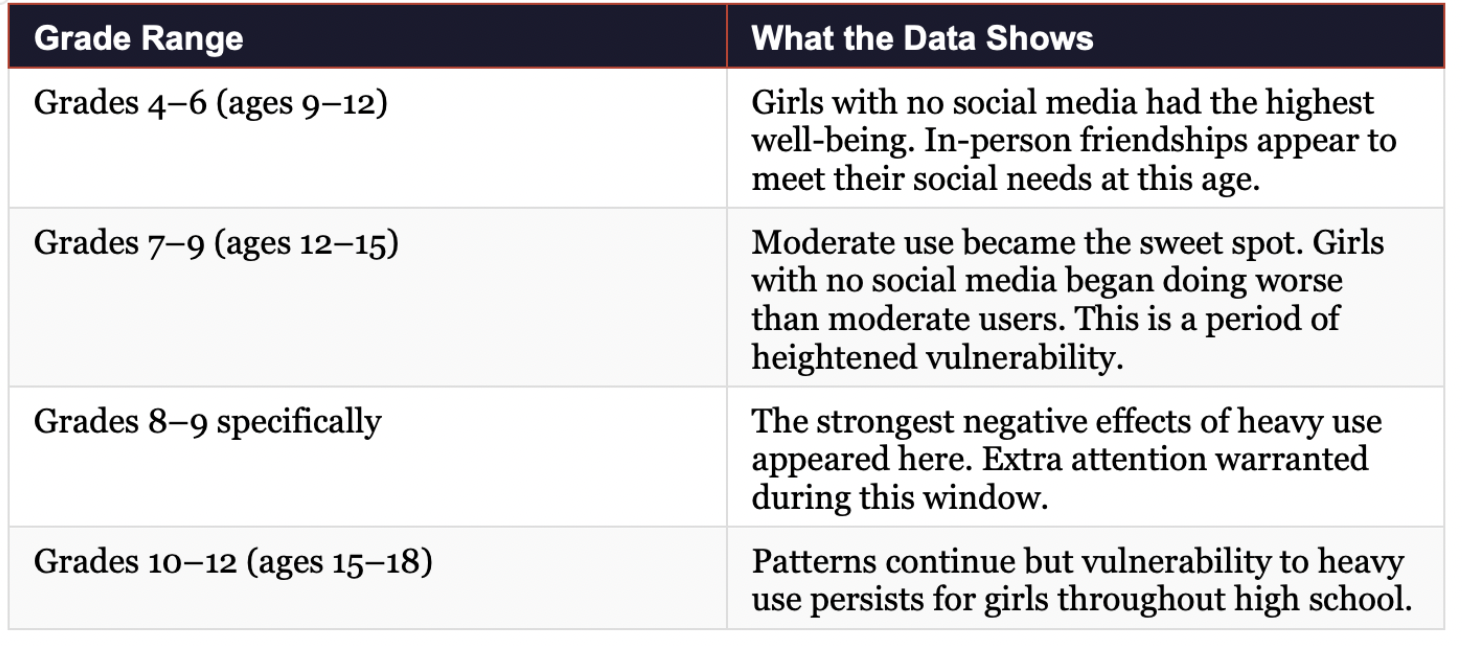
The practical takeaway for parents of daughters: delaying social media use through elementary school appears genuinely protective for girls. But by middle school, a complete ban may no longer offer the same advantage — and may begin to carry its own costs in terms of social connection.
What the Data Says for Boys
Boys show a different pattern that surprises most parents:
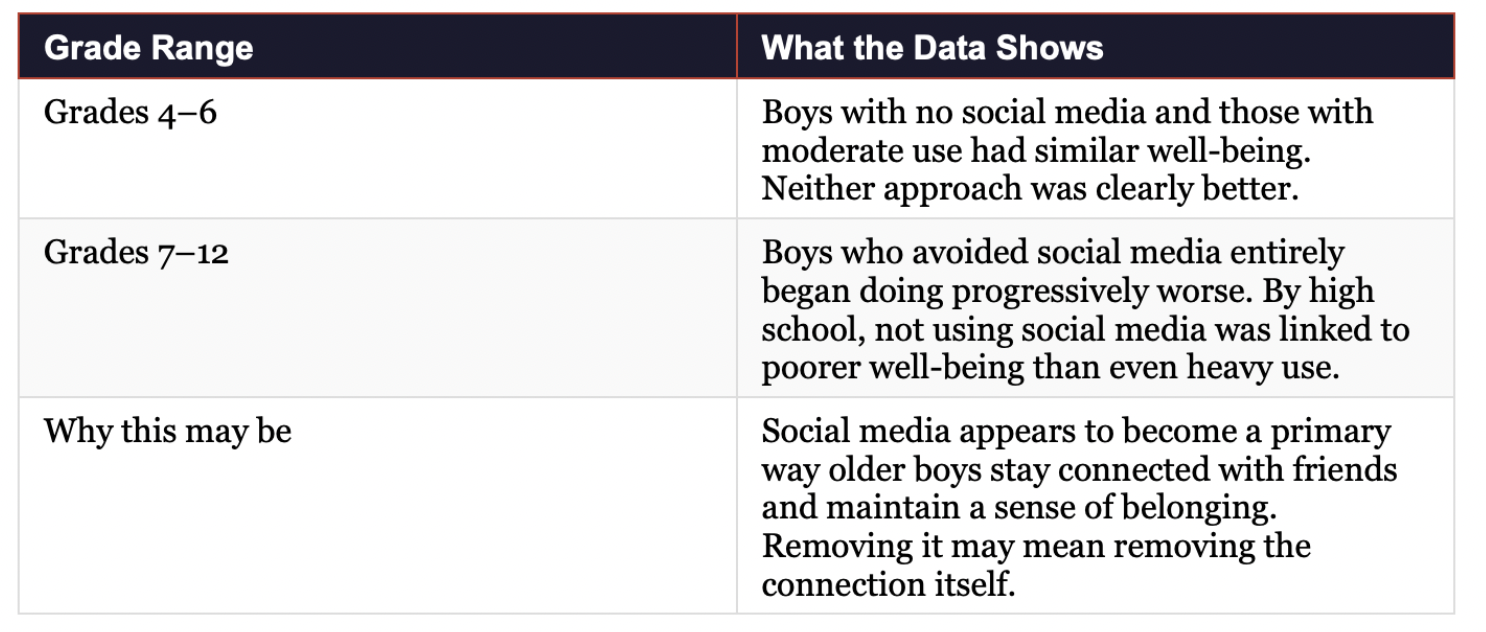
This finding consistently surprises parents. Boys in particular may be using social media primarily to coordinate and stay connected with real-world friends — and removing it cuts that thread.
What Counts as "Too Much"?
This matters more than most people realize. In this study, the threshold for "high use" was approximately 2 or more hours of social media per weekday afternoon — specifically the 3 to 6 PM after-school window. That translates to roughly 12.5 or more hours per week.

The other important detail: the study measured time only — not what kids were doing with it. Scrolling passively through a feed of strangers is not the same as direct messaging with actual friends. The authors themselves flag this as a key limitation and explicitly call for future guidelines to move beyond time-based measures to consider purpose and context.
What This Study Can — and Cannot — Tell Us
I want to be honest about the limitations, because they matter for how you apply this information.
This is an observational study, not a controlled experiment. It shows associations, not proven cause and effect. Teens who are already struggling may gravitate toward heavier use, and teens who avoid social media entirely may already be more socially isolated — the study design cannot fully untangle this.
The study used self-reported data. Kids estimated their own usage, which research consistently shows is imprecise in both directions.
It did not distinguish between platforms. Instagram, TikTok, Snapchat, and a group chat with five friends are all "social media" in this dataset. They are not the same thing.
It is based on Australian adolescents. Cultural context, social norms, and platform availability may differ from your family's environment.
None of these limitations invalidate the findings. They mean we should hold them as directional guidance rather than precise prescriptions.
What This Means for Your Family
Here is how I am thinking about it — as both a pediatric eye surgeon who sees the effects of screen time in my clinic every week, and as a mom who is navigating the exact same decisions you are:
1. Age matters more than you think
The same rule doesn't work for a 10-year-old and a 15-year-old. For younger children — especially girls — delaying is genuinely protective. For older teens, particularly boys, complete restriction may carry its own costs. Revisit your family's approach as your child ages, not just when there's a conflict.
2. Ask about purpose, not just minutes
Is your child texting three close friends to plan the weekend? Or are they alone, scrolling strangers' highlight reels at 11 PM? The amount of time matters less than what they are doing with it. A 30-minute daily window of genuine social connection is very different from 30 minutes of passive consumption.
3. Middle school is the highest-stakes window
Grades 7 through 9 emerged as a period of heightened vulnerability in this study — especially for girls. This is not the time to relax attention. It is the time for more frequent check-ins, more open conversations, and closer attention to how your child feels after time online.
4. Watch your child, not the clock
The study's own authors make this point. Are they more anxious after using it? More withdrawn? Less interested in in-person friends? Emotional response is a better indicator than screen time minutes.
5. Build skills, not just rules
Shielding kids from social media entirely becomes harder — and potentially counterproductive — as they get older. The goal is helping them build the capacity to recognize when content makes them feel bad, understand that online life is curated, and put the phone down when they need to. This requires practice, not just prohibition.
My daughter made a reasonable argument using real data. What she's not ready for yet isn't the information — it's the judgment to act on it wisely. That's what we're still working on. Together.
The Bottom Line
The research suggests we need to move beyond the question of "how many minutes" and toward the more complex questions: How old is my child? What are they doing on it? How are they feeling? What are they missing by being on it, and what might they miss by not being on it?
Neither a complete ban nor unrestricted access is what the evidence points to. What it points to is exactly what good parenting has always required: staying informed, staying present, and being willing to adjust as your child grows.
My daughter is still not getting Instagram…yet. But the conversation we had about why — using real data, asking real questions, disagreeing respectfully — is exactly the kind of digital literacy that will matter when she eventually does.
REFERENCES
[1] Singh B, Zhou M, Curtis R, Maher C, Dumuid D. Social Media Use and Well-Being Across Adolescent Development. JAMA Pediatr. Published online January 12, 2026. doi:10.1001/jamapediatrics.2025.5619
[2] American Academy of Pediatrics. Digital Ecosystems Technical Report, 2026.
Rupa K. Wong M.D. is a pediatric ophthalmologist, practice owner at Honolulu Eye Clinic, and host of the In Focus podcast. This post is for informational purposes and does not constitute medical advice. Always consult your child's healthcare provider regarding individual concerns.