
Minimizing Complications: What Questions to Ask Your Surgeon Beforehand | Uday Devgan, MD
Listen On


If you’ve ever heard someone say, “Cataract surgery is quick and routine,” I get it. From the outside, it can look that way.
But here’s what I tell people (and what today’s guest says perfectly):
Cataract surgery is a brief procedure that takes decades and five minutes.
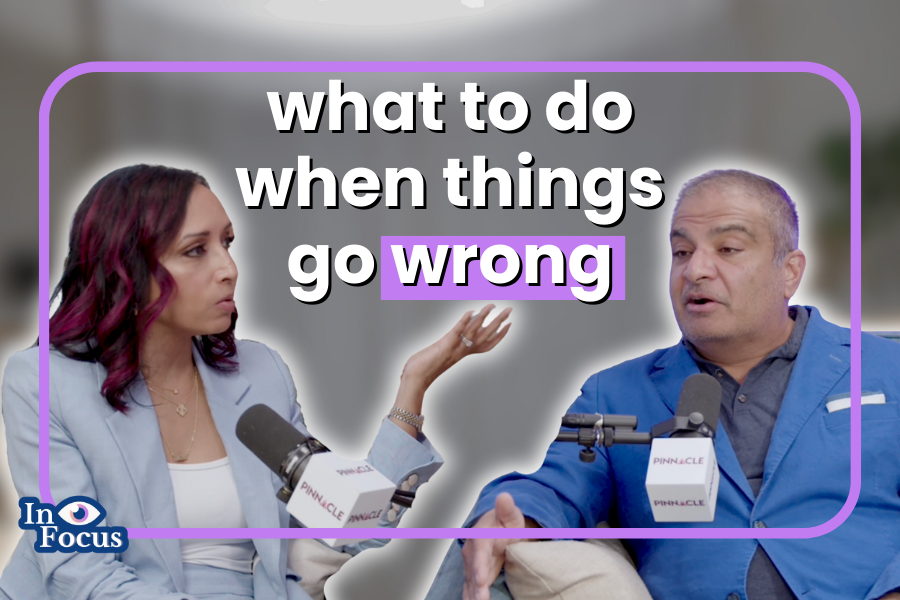
In this final episode of our cataract surgery series, I sat down with Dr. Uday Devgan—one of the most respected cataract surgeons and educators in the world—for a candid, practical conversation about what actually keeps patients safe.
Dr. Devgan is the founder of CataractCoach.com, a globally-used surgical teaching platform, and he’s trusted by other ophthalmologists to operate on their eyes—which tells you everything about the caliber of care he delivers. We covered the parts of cataract surgery that don’t always make it into the “routine and easy” narrative: the subtle warning signs, the reality of complications, how surgeons recover when something goes off-script, and the patient conversations that matter just as much as the surgery itself.
This is for:
Patients and families who want to understand what safety really looks like
Ophthalmologists at any stage who want practical pearls that translate to the OR immediately
Let’s get into it.
The most common root cause of complications: missing the “early whisper”
When I asked Dr. Devgan what he sees behind many complications, his answer was simple—and honestly, humbling:
A lot of complications start because something subtle was happening… and it wasn’t recognized early enough.
That’s where surgical video changes everything.
He gave an example that stuck with me: during phaco (ultrasound cataract removal), a surgeon may see a faint “smoke sign”—tiny particles that aren’t being aspirated because the tip is clogged. If the surgeon doesn’t recognize that early and instead pushes more energy, that can lead to a wound burn.
But when surgeons watch videos of these moments—mistakes included—they start recognizing the “whispers” before they become disasters.
Dr. Devgan told a story I love: after he posted a video like this, a resident sent him a clip later saying, “I saw the smoke sign, stopped immediately, cleared the blockage—and prevented the complication.”
That’s the power of learning without “learning on your own patient.”
The learning curve has changed—and that’s a good thing
One of the best parts of modern training is that younger surgeons can compress experience faster than previous generations.
Dr. Devgan said it plainly:
“The new generation can learn in one year what took me ten years.”
Not because the surgery is easier—but because education is better, more visual, and more accessible.
And if you’re practicing outside a major academic hub (I’m in Hawaii—so I felt this deeply), the ability to stay current through surgical video isn’t a “nice-to-have.” It’s how you keep your standards high no matter your zip code.
The thing surgeons often underestimate: patient expectations
This section matters for every patient reading this.
Dr. Devgan put it in a way I think is incredibly true:
Patients don’t want “pretty good.” They want perfect.
And cataract surgery is unique that way—because so many people know someone who had it, and the success stories are everywhere.
That means the pre-op conversation is not just paperwork. It’s safety.
The phrase I’m keeping:
Under-promise and over-deliver.
He compared it to a restaurant wait time (and it’s such a perfect analogy): tell someone 25 minutes and seat them at 15, they’re thrilled. Tell them 10 and seat them at 15, they feel misled—even if the result is the same.
The “golden rule” approach to cataract surgery
This was the thesis of the entire conversation:
Give every patient the same care you would want for your own eyes.
Not just the big decisions—every tiny detail:
meticulous draping (no lashes anywhere near the field)
clean incision architecture
thoughtful antibiotic prophylaxis
using the tools you believe are best (not just “what’s easiest”)
And I loved his point about decision-making: sometimes we accidentally ask patients to choose between options they have no meaningful way to evaluate.
His example: even if you’re a physician, if you needed a hip replacement tomorrow, would you truly want to pick the material and design yourself?
Most patients want what we’d want too:
“For my anatomy, my lifestyle, and my needs—what’s best for me?”
That’s a powerful question for patients to bring to a consult.
The complications no one wants, and the ones we see more often
The most dreaded post-op complication: endophthalmitis
This is a rare but severe infection inside the eye. Dr. Devgan noted that despite best practices, it can still occur—rarely, but with high stakes.
And that’s why post-op access matters:
patients must know how to reach their surgeon
post-op day 1 checks matter
“If anything feels off—call.”
The most common post-op issue: cystoid macular edema (CME)
CME is swelling in the retina (the macula) after surgery. A surgery can look flawless, and CME can still happen because healing responses vary.
A key patient-facing point he shared:
The outcome is not only the surgery. It’s also your tissue and your healing response.
That’s not blame—it’s biology.
And in most cases, the reassuring part is:
CME typically resolves. It may just take time.
When something goes wrong in surgery: what matters most is the next 10 seconds
This is where the conversation got very real.
Dr. Devgan said the most dangerous reflex is denial—followed by the worst reflex:
panic-pulling instruments out of the eye.
Example: posterior capsule rupture (PCR). If the chamber collapses because the surgeon yanks out quickly, vitreous can prolapse forward and the situation escalates.
His intra-op mindset is what I want every surgeon to hear:
Recognize what happened (no denial)
React appropriately (stabilize, don’t escalate)
Rescue the case (slow down, treat it like a referral complication you’re here to fix beautifully)
And one pearl that sounds simple but changes outcomes:
Give more anesthesia/sedation if the case is shifting into a more complex repair.
Comfort affects cooperation, and cooperation affects safety.
Three practical habits that reduce complications (for any surgeon)
I asked for the simplest things that translate across skill levels. Here’s what he emphasized:
1) Learn every day
Watch surgical video consistently so you recognize subtle warning signs early.
2) Don’t deny reality
When something happens, acknowledge it and shift into a steady, problem-solving mode.
3) Rescue with intention
Stabilize the eye, protect the patient, consider suturing the wound, follow closer post-op if risk increased.
And then he added a “bonus R” that I agree with completely:
4) Record your surgeries and watch them
Even elite athletes watch film. Surgeons should too.
Not to shame yourself—because you can’t improve what you don’t see.
The future: robotics, lasers, and “no-fly zones”
We also talked about emerging tech—especially robotics—and why it could meaningfully reduce complications.
One concept he described that really made sense: reaction time and consistency.
Humans react in fractions of a second. Machines can react faster—and they can create safety barriers, like a “no-fly zone” near delicate structures (like the posterior capsule), using integrated real-time imaging.
I appreciated his balanced approach:
more tools in the toolbox is good
technology should serve outcomes—not marketing
the surgeon still has to do the surgery
The patient conversation I’m taking into clinic
When I asked Dr. Devgan how he explains expectations to patients, his best framing was this:
You want young vision again. I want that too. But that’s not reality.
What I can do is aim to take your vision back to a конкретely remembered time—like age 50.
That’s a reference point patients can understand. It turns vague promises into something grounded and honest.
And that honesty is what creates trust.
Final takeaway
If I had to summarize this entire conversation into one line, it’s this:
Safety isn’t one big moment. It’s hundreds of small decisions—before, during, and after surgery—made with skill, humility, and consistency.
Patients deserve surgeons who keep learning. Surgeons deserve systems that help them keep learning. And all of us—patients and physicians—benefit when we’re honest about what cataract surgery can do, what it can’t do, and how we manage the rare moments when things don’t go perfectly.
Want to Learn More?
This is just the beginning. In upcoming episodes, we’ll explore:
-How screen time and digital habits are shaping our kids’ development
–The connection between vision and overall health
–What you need to know about common eye procedures like LASIK and cataract surgery
–Practical ways to advocate for your child’s visual needs
You can subscribe to my podcast, In Focus, anywhere you listen—or follow along on Instagram for updates and tips.
Watch this episode on Youtube right now!
Thanks for reading—and for doing what you can to protect your child’s vision, one step at a time.
– Dr. Rupa Wong
Pediatric Ophthalmologist | Surgeon | Mom of 3
This episode is brought to you by The Pinnacle Podcast Network! Learn more about Pinnacle at learnatpinnacle.com