
Financial Support: Supported by an educational grant from Tarsus Pharmaceuticals, Inc. & Rxsight
Listen On


As a pediatric ophthalmologist and adult strabismus surgeon, I spend most of my days taking care of kids and adults with eye misalignment. But as my own parents have aged, I’ve also stepped into a role that many of you are in right now: helping a loved one navigate cataract surgery… or starting to think about it for myself.
Cataracts are something almost all of us will face if we live long enough. They’re common, they’re fixable, and in 2025, cataract surgery is more customizable than ever before.
To really unpack all of this, I turned to someone whose entire career is centered around cataract surgery and advanced lens technologies: my friend and colleague, Dr. Priya Mathews, a board-certified ophthalmologist, fellowship-trained in cornea and refractive surgery, and Director of Cornea and Ocular Surface Disease at Center for Sight in Sarasota, Florida. She performs hundreds of cataract surgeries a month and lives and breathes this world every day.
This blog is a written version of our conversation, with your questions in mind—whether you’re thinking about surgery for yourself, a parent, or just want to be prepared for the future.
What is a cataract, really?
Think of your eye like a camera. In addition to the clear front “window” (the cornea), you also have a lens inside the eye that bends light and focuses it onto the retina so you can see clearly.
You’re born with this lens, and it’s crystal clear for much of your life. Over time—usually after age 50—it starts to change. Proteins in the lens reorganize, the lens becomes more cloudy, and light doesn’t pass through as cleanly.
That cloudy lens is called a cataract.
A few important points Dr. Mathews emphasized:
Cataracts are normal aging.
If you live long enough, you will get a cataract. It’s not a failure or something you “did wrong.”They don’t always progress at the same rate.
Genetics, sun exposure, radiation, steroid use, certain medical conditions, and other environmental factors can speed things up.You might hear the word “cataract” earlier than you expect.
People in their 40s and 50s are often shocked when they’re told they have a “trace cataract.” That doesn’t mean you’re headed straight to surgery—it just means the aging process has started.
And this is key: the ophthalmologist telling you that you have a small cataract is not trying to “sell” you surgery. We actually like telling you early, so it doesn’t come as a surprise later.
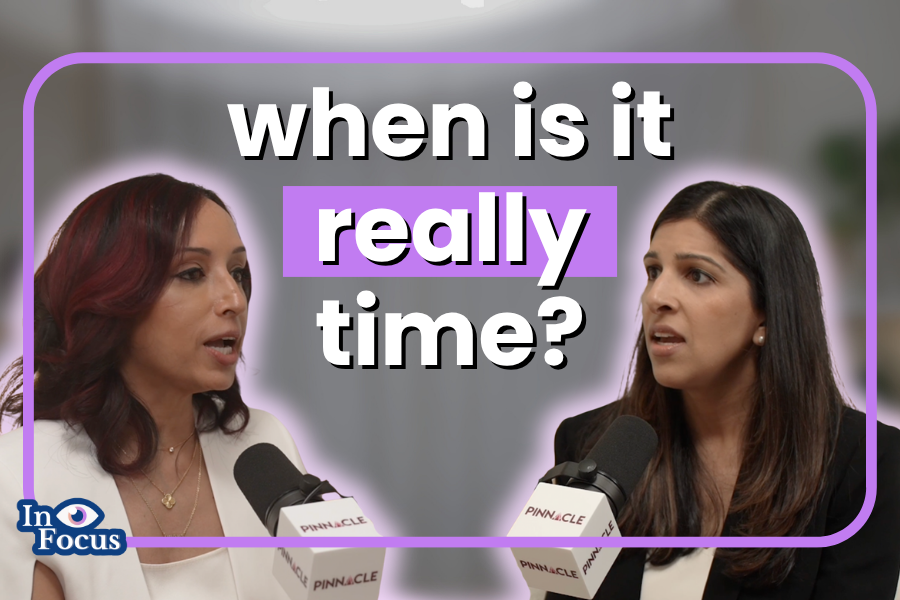
When is it actually time for cataract surgery?
This is the big question everyone asks.
In the “old days,” people used to say, “We’ll wait until your cataract is ripe.” That’s very outdated thinking.
Today, the decision is less about how the cataract looks and more about how you’re functioning.
Here’s how Dr. Mathews frames it:
It’s time to consider cataract surgery when your cataracts are interfering with the things you need and love to do—and glasses no longer fix it.
That might look like:
Struggling with night driving because of glare and halos
Having trouble reading, sewing, or stitching even with new glasses
Noticing that golf, pickleball, or other hobbies feel harder visually
Feeling like everything is dimmer, hazier, or less crisp than it used to be
Your ophthalmologist will also confirm that:
The cataract is truly the main reason for your vision changes
The rest of the eye (retina, optic nerve, cornea) is relatively healthy
Two common misconceptions she sees:
“I should wait until it’s really bad.”
Waiting doesn’t earn you any “points.” In fact, you may lose years of good-quality vision, and very dense cataracts can make surgery harder and slightly increase the risk of complications.“I’m too young for cataract surgery.” or “Isn’t this just for people over 70?”
Her average cataract surgery patient is in their early 60s, and she does plenty in patients in their 50s. Our expectations for vision are different now—people in their 60s and 70s are still working, traveling, and very active.
And on the flip side…
“I’m too old for surgery.”
She has operated on many patients in their 90s and even around 100. One of her favorite stories is her grandmother, who delayed surgery saying, “I’ll die before I need it,” finally had cataract surgery at 99, and then lived to 103—reading the newspaper daily.
Improving vision at that age can reduce falls, increase independence, improve mood, and reconnect people to the world around them.
How should you feel if your doctor says, “You have a small cataract”?
This comes up all the time—even in my own clinic when I see adult patients for strabismus.
If you’re in your late 40s or 50s and your ophthalmologist says you have a small or “early” cataract, here’s what it doesn’t mean:
It does not mean you need surgery right away.
It does not mean your eye is “diseased.”
It does not mean something dangerous is happening.
What it does mean:
Your lens is starting the normal aging process.
Your doctor is giving you a heads-up so it won’t feel like a sudden crisis later.
You’ll be monitored over time, and when your daily life is impacted, you can move forward with surgery with more confidence.
Standard vs. laser-assisted cataract surgery
Now let’s talk about the “how.”
At its core, cataract surgery is:
Removing the cloudy natural lens
Replacing it with a clear artificial lens (called an intraocular lens, or IOL)
Traditionally, surgeons have done this manually using tiny instruments and ultrasound energy to break up and remove the cataract.
With laser-assisted cataract surgery, a femtosecond laser is used before the main part of surgery to:
Pre-soften and break up the cataract into pieces, and
Make very precise, curved incisions on the cornea to help correct astigmatism (when the front of the eye is shaped more like a football than a basketball)
What does the patient experience?
You’re taken to a separate laser room (in most practices).
The laser portion for one eye takes about 90 seconds.
You’ll feel some pressure/suction and see some lights, and then you’re done and moved to the operating room for the actual cataract removal and lens placement.
So, is laser cataract surgery “better”?
Here’s the honest answer from Dr. Mathews:
In the hands of a skilled surgeon, you can get excellent outcomes with either manual or laser-assisted surgery.
Where laser really shines is in fine-tuning astigmatism and marking the eye so toric (astigmatism-correcting) lenses can be placed more precisely.
For certain corneal conditions (like Fuchs’ dystrophy or some trauma cases), reducing the ultrasound energy inside the eye by pre-softening the cataract with a laser may have theoretical advantages.
Who should not have laser-assisted surgery?
Patients with corneal scarring that can interfere with the laser’s ability to pass through the front of the eye
Patients whose surgeon examines the eye and feels that manual surgery is safer or more appropriate given the anatomy
One more important note:
Laser-assisted cataract surgery and many astigmatism-correcting steps are often considered “premium” and not covered by insurance in most cases. That’s not because they’re cosmetic, but because of how the procedures are categorized.
Choosing a lens: monofocal, multifocal, or light-adjustable?
This is the part that overwhelms people the most—and where having a surgeon like Dr. Mathews who truly listens to your lifestyle makes all the difference.
She looks at two main things before she walks into the room:
Your eye anatomy and measurements
Corneal shape (topography)
Health of the retina and optic nerve
Astigmatism
Any other eye conditions
Your lifestyle and visual priorities
Do you golf? Sew? Read for hours? Work on a computer all day?
Do you hate wearing glasses, or are they part of your identity?
Is night driving important?
Do you have a very detail-oriented hobby?
From there, she narrows lens options into categories, not just brand names.
1. Monofocal lens (one focal point)
This is the “classic” lens and still an excellent option.
Gives you clear vision at one distance (usually distance)
You will still need glasses for reading and computer work
You can add astigmatism correction (with laser or a toric IOL) to sharpen that single focal point
Best for people who:
Don’t mind wearing glasses
Have worn glasses since childhood and feel “naked” without them
Prioritize crisp distance vision and are comfortable using readers
2. Multifocal / extended-depth lenses (multiple focal points)
These lenses are designed to give you:
Distance
Intermediate (computer / dashboard / arm’s length)
Near (book / phone)
They offer the convenience of not relying on glasses for most tasks, but there are trade-offs:
Halos and glare at night, especially around headlights
Reduced contrast sensitivity, meaning reading in low light (dim restaurants, cozy lamp light) may still feel harder than with very bright light
That doesn’t mean they’re “bad” lenses—just that it’s a trade: more glasses independence in exchange for some visual phenomena, especially at night.
3. Light-adjustable lens (LAL): “tailoring” your vision after surgery
This is the newest category and the one Dr. Mathews is especially excited about.
Instead of locking in the prescription before surgery, a light-adjustable lens can be fine-tuned after surgery using UV light treatments in the clinic.
How it works:
You have cataract surgery and the light-adjustable lens is placed.
Over the next few weeks, as the eye heals, you come in for short adjustment visits (about 1–2 minutes of UV light per treatment).
You “test drive” your vision between visits—golf, work, read, use your devices—then come back and fine-tune again if needed.
Once you and your surgeon are happy, the lens is “locked in” with final treatments.
This lets your surgeon:
Customize your dominant eye more for distance
Offset the non-dominant eye slightly to give more reading vision
Find the sweet spot that fits your life, not a generic target
Older versions of this technology required very strict UV-blocking glasses at all times to prevent accidental lens changes. With newer ActiveShield technology, there’s an added layer of protection, so a moment of forgetfulness with the glasses is unlikely to cause issues—though you still follow your surgeon’s instructions.
How do you know what’s right for you (or your parent)?
This is where a thoughtful, experienced cataract surgeon matters more than any single lens technology.
Questions to think about before your visit:
What are the top 3 things you want to see clearly without glasses?
How much do you drive at night?
Do you do a lot of reading? Computer work? Close detail work?
Would halos or glare at night really bother you?
How do you feel about wearing glasses some or all of the time?
Then, bring those answers into the exam room and say them out loud. That makes it much easier for your surgeon to recommend a path that fits—not just what’s available, but what’s appropriate for your eyes and your life.
The bottom line
Cataract surgery today isn’t just about “getting the cataract out.”
It’s about:
Understanding that cataracts are a normal part of aging, not a personal failure
Choosing the right time, based on your quality of life
Deciding with your surgeon whether standard or laser-assisted surgery makes sense
Matching the lens choice to your eyes, personality, and lifestyle
If you or a loved one has been told, “You have cataracts,” I hope this helps replace anxiety with clarity.
Use this as a starting point to ask better questions, advocate for yourself or your parents, and feel more prepared when it’s time to make those decisions.
And of course, this blog isn’t personal medical advice—always talk to your own eye doctor, who can look at your specific eyes and guide you through the best options for you.
Want to Learn More?
This is just the beginning. In upcoming episodes, we’ll explore:
-How screen time and digital habits are shaping our kids’ development
–The connection between vision and overall health
–What you need to know about common eye procedures like LASIK and cataract surgery
–Practical ways to advocate for your child’s visual needs
You can subscribe to my podcast, In Focus, anywhere you listen—or follow along on Instagram for updates and tips.
Watch this episode on Youtube right now!
Thanks for reading—and for doing what you can to protect your child’s vision, one step at a time.
– Dr. Rupa Wong
Pediatric Ophthalmologist | Surgeon | Mom of 3
This episode is brought to you by The Pinnacle Podcast Network! Learn more about Pinnacle at learnatpinnacle.com